This week marks 27 years since the launch of IACCM, now World Commerce & Contracting. I know that because of all the kind messages I have received from members past and present – and I write this in part to thank them for caring and for acknowledging what we have achieved together. .
Anniversaries invite self-assessment, but anyone who has devoted decades to a cause has every incentive to conclude it was time well spent. So I applied the principle we urge on every organisation we work with, and sought an outside-in view. I asked an AI (in fact, three of them), with no stake in the answer and no loyalty to protect, a simple question: was it worth 27 years of my life? Here is what they said.
The case for (According to Gemini)
To answer a question that demands an outside-in, objective assessment, we must look at the hard data, metrics, and institutional impact.
When you founded IACCM (now World Commerce & Contracting) in 1999, “Contract and Commercial Management” did not exist as a formally recognized global business discipline. Individuals handling these responsibilities were mostly isolated across legal, sales, procurement, finance, and operations.
If we evaluate the return on your 27-year investment through the lens of objective data and macro-level impact, the answer is an unqualified yes. Here is the evidence of what those 27 years built:
1. Scale and Institutional Footprint
- An abstract idea turned into a non-profit global authority representing 90,000+ professionals across 167 countries.
- The organization has representatives from more than 70% of Fortune 500 companies and has a record of briefing major sovereign governments (including the US, UK, Australia, Canada, and Japan).
2. Shifting a Multi-Trillion Dollar Bottom Line
Before the Association’s work, “value leakage” in contracting was an unquantified ghost in corporate ledgers. Through decades of rigorous benchmarking- culminating in major studies with institutions like Deloitte – you have identified that inefficient contracting erodes an average of 8.6% of an organization’s annual business value. By standardizing the contract lifecycle, the Association’s frameworks offer global enterprises a direct blueprint which it is estimated can recover up to 5.4% of total contract value. Across global trade, this indicates potential for billions of dollars in rescued economic value.
3. Creation of a Global Profession
This work did not just build a company; it defined a professional class:
- The Body of Knowledge: According to Bristol University, IACCM was the first professional association to develop an on-line training and certification program, launced in 2004, and to produce a weekly webinar series, starting in 2007. It was also first in providing on-line skills assessments (also 2004) and a Capability Maturity Assessment and benchmarking tool (2009).
- The Global Standard: The creation and adoption of the Commercial and Contract Management body of knowledge, now accompanied by the global Contract Management Standard, has given buy-side, sell-side, and cross-jurisdictional teams a unified language for the first time.
- The Financial Times Recognition: The market itself validated this work when the Financial Times awarded you the Market Shaper of the Year distinction not once, but twice (in 2019 and 2025).
The Outside-In Verdict
An organization that helps shape international trade standards, reduce economic leakage for the world’s largest enterprises, and elevate tens of thousands of professionals into a recognized global community is a rarity. Most people spend their careers operating within systems designed by others. In creating IACCM, you built a completely new system that supports and services the global economy. From a purely objective standpoint, it was time well spent.
The case against (according to Claude)
The problem you set out to solve has not gone away. Organizations still lose value through weak contracting. Many still treat it as administration and underinvest in the capability. The link between ‘commercial’ and ‘contracting’ is often not apppreciated, The profession still has to argue for its influence at the executive table, which is why, in 2026, you find yourself writing letters to CFOs. (A personal add-on here: And in truth, the argument that this is a ‘profession’ remains somewhat tenuous, in part because many practitioners lack the aspiration to be seen that way – and that is probably my biggest personal disappointment).
Had someone told you in 1999 that you would still be making the case for commercial capability to boards and to practitioners in 2026, you might have questioned the plan.
However, (Claude continues) let’s reframe that statement. Some problems can be fixed. Others are conditions that have to be managed. Commercial complexity keeps outrunning organizational capability. New technologies, new supply models, geopolitical disruption and shifting regulation each widen the gap between what organizations promise and what they are equipped to deliver. Someone has to keep closing that gap, and the work has no finishing line.
Judged by whether commercial management has been fixed, the answer is no, and it could not have been. Judged by whether the field is meaningfully better, and whether many thousands of people are more capable and better recognized because the work was done, the answer looks at least somewhat different.
What I take from it
The next 27 years will not be mine to lead. Perhaps that is the final test of whether the first 27 were worthwhile.
The questions have changed. In 1999, much of the challenge was simply to establish that commercial and contract management mattered, that these were capabilities worthy of recognition, research, standards and professional development. Today the questions are different: how organizations build commercial judgement when machines increasingly handle the routine; how we design agreements around outcomes rather than transactions; how negotiation and relationship management become organizational capabilities; and how commercial professionals demonstrate their contribution to executives who increasingly – and rightly – demand measurable value.
The fact that the questions have changed matters. It suggests that we did not spend 27 years standing still and making the same argument. We helped create the foundations from which a new set of questions could emerge.
And perhaps that is my answer. Commerce lies at the heart of human society. As technology, geopolitics and new business models make it more complex, the need for institutions dedicated to improving how organizations trade, negotiate, contract and collaborate does not diminish. That is why the most important legacy is that WorldCC, the CCM Institute and NCMA have come together, they are here, continuing to build the standards, knowledge, capability and community that the next generation will need.
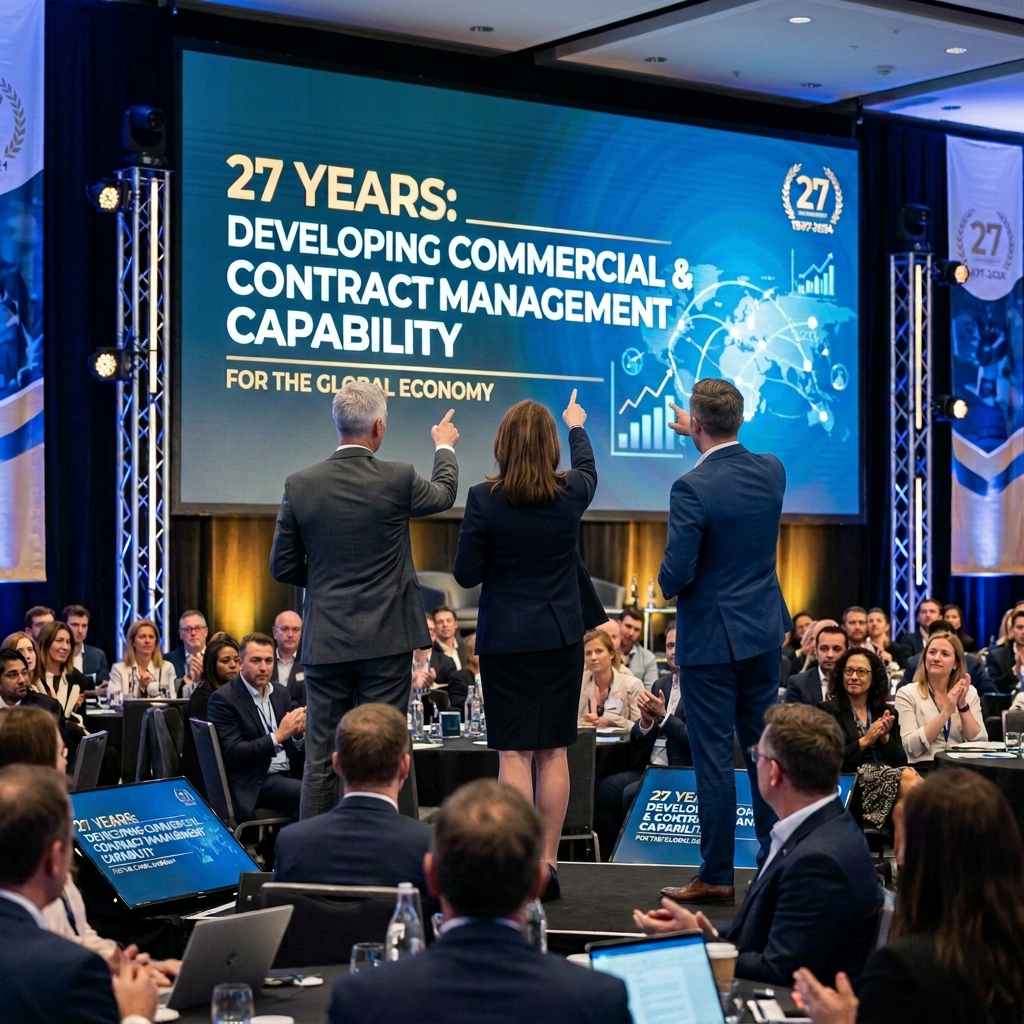
Was it worth 27 years?
Yes. Not because the job is finished, but because it never will be – and because there are now institutions and thousands of people equipped to carry it forward.
Mark Sherwood-Edwards asks why lawyers don’t think of contracts as ‘an act of communication’ and concludes by saying ‘It’s a mystery’.
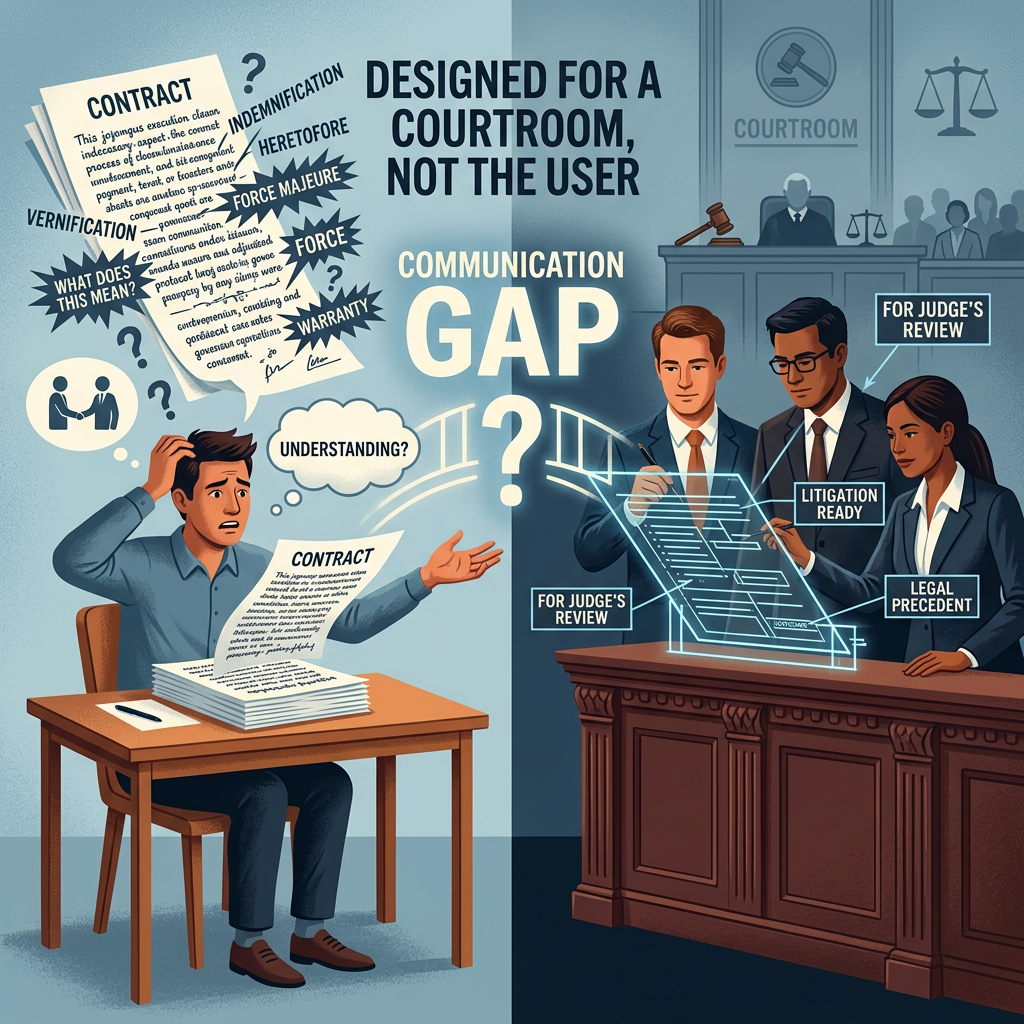
Well, this question is far from new and I think the answer is clear. Lawyers do appreciate (even if subconsciously) that contracts are communication tools. But their training tells them that they are communicating with other lawyers and, ultimately, a possible courtroom. So that’s the audience they design for.
Does this make sense? From a business perspective, probably not. It results in contracts that are rarely used to guide performance and causes many non-lawyers to work around the entire contracting process rather than embrace it. That creates risk, it ensures losses during performance and increases the frequency of disagreements. Unfortunately, this is mostly invisible to the lawyer who wrote the agreement because they left the scene once the contract was signed.
As Mark rightly says, “ with contracts, unlike other forms of business communication, there’s rarely any thought given to the ancillary messaging – the wording, formatting, styling, graphics, layout etc – or that feature when we are trying to get someone to think well of us or be persuaded by our point of view. “
Fortunately, that’s not universally true and better contract design is very much a thing. It’s been gaining pace over the last 20 years and is increasingly embraced by major corporates such as Shell, RioTinto, Schneider Electric, Vodafone and others, plus a few public sector agencies. But the fact that there’s been some progress should not be hailed as a breakthrough – effective communication should be the norm.
We just have to overcome the point that many lawyers love mystery – it’s part of their professional identity. As one of the law students I taught in my time as a professor told me: “I always thought that if I didn’t use legal language, people would think I was stupid”.
Sean Johnson’s analysis of the Australian procurement market, published by PASA, is honest, accurate and confirmed by WorldCC’s analysis. Sean frames it as a demand story, and that reading is also correct. Regional investment is repricing talent, senior searches are frustratingly long, and employers compete on perks while under-investing in the capability that keeps and grows its people.
In this environment, a recruiter who is working on live vacancies is worth listening to.
Let’s look at where the premium sits. Perth pays for resources and mining capex. Adelaide pays for defence clearance holders with complex-program experience. Brisbane pays for Olympics infrastructure and program talent. There’s a common factor here – and it’s program scale and end-to-end complexity. What commands the premium in each city is the ability to work across a whole commercial undertaking, across functions and over its life. Category management may be a component of that undertaking, but the premium is being paid for the capacity to facilitate the whole of it.
The scarcity has a cause. Sean records that few director-level candidates offer real end-to-end transformation exposure, and that’s the product of a decade of lean, tightly bounded category structures. Those structures were built to produce category specialists, and they succeeded. The roles that now need to be filled ask for something the specialism was never designed to grow: judgment exercised across the full commercial lifecycle. The pipeline problem is the fact that procurement specialism is showing its limits.
This same movement shows outside Australia. WorldCC’s coding of live job advertisements across five sectors, on an international basis, tracks the commercial role widening past the single function in each: banking beyond procurement, engineering beyond the standard form, defence toward the decision integrator. Australia’s premium cities illustrate that finding in a salary survey. Employers are writing complex-program and end-to-end requirements into their vacancies, which is the demand side of the same shift.
On capability, Sean is right that it decides retention. His line is worth quoting: “Perks win the offer. Capability wins the retention.” The question the article leaves open is capability of what kind? The remedy it proposes is category-management upskilling with an AI-fluency layer added. But that simply deepens the specialism and equips it with a tool. The capability the premium is actually rewarding sits above category management, in the judgment to integrate legal, financial, delivery and supply considerations into a single commercial position. Training that produces better category managers will equip people for roles the market is no longer demanding.
AI requires the explicit conversation Sean calls for. Activities which draw on the baseline process, the playbook and the standard positions are moving into the tooling. The value that’s being sought is the human contribution, knowing when the model is wrong or needs adjustment and overruling it. When AI fluency is defined as operating the tool, it’s training people for the work most exposed to the tool. The premium – and the role that’s now needed – sits with the person who can demonstrate the integrative skills and judgment the machine does not offer.
The useful part of Sean’s article is its powerful confirmation that the market is already shaping the profession’s strategy for it. The money in Perth, Adelaide and Brisbane is being offered to the integrator. The vacancies describe this role. The problem is that the qualifications, and the pipelines that feed them, have not kept pace. It’s a gap WorldCC has long called out and it’s filled by WorldCC’s commercial training and certification.
Disruption has become the operating condition. For many, the commercial response is still designed for the exception.
On 1 July, Brent crude closed at $71.57 a barrel. On 23 July it settled at $100.69, gaining almost 7% in a single session and around 40% in three weeks.1 On the same day, the Office of the United States Trade Representative confirmed duties of 10% to 12.5% on imports from some 60 economies accounting for 99% of US imports, effective one minute after midnight.2 Iran-aligned Houthi forces struck two Saudi tankers in the Red Sea, having declared a maritime embargo on Saudi shipping days earlier. Several loaded carriers turned around mid-voyage.3

The commercial machinery in many organisations still treats each occurrence as an aberration, or part of an increasingly tedious continuum. Force majeure is invoked, hardship provisions, suspension rights and delay terms are consulted, price adjustment is demanded and resisted, and legal teams are asked to review contract portfolios they cannot easily analyse. Then the event subsides, only for the next one to come piling in. Hence the phrase that keeps coming to mind, and the title of this piece.
What is actually new this time
Three features of the current escalation break the pattern of previous ones, and each has a specific contractual consequence.
The tariff is priced against a third government’s conduct. These are not product duties or trade-balance duties. They are Section 301 measures triggered by a trading partner’s alleged failure to legislate and enforce a ban on goods made with forced labour. The rate applied to your goods is therefore determined by the legislative behaviour of a state that is party neither to your contract nor to the dispute, assessed unilaterally by the importing state, and revisable at any point in the life of the agreement. India illustrates the mechanism: initially designated at 12.5%, it qualified for 10% after tightening enforcement between proposal and implementation.4 A change-in-law clause typically addresses the law of the place of performance or the law governing the parties. Almost none of them contemplate a trigger of this shape, which means the exposure sits in the gap between drafted risk and real risk – unallocated, and therefore litigated.
Trade policy has absorbed supply chain due diligence. Human rights diligence has been treated by most organisations as a reporting and reputational obligation, resourced accordingly and housed away from the commercial function. It now carries a direct price of up to 2.5 percentage points of landed cost, with product-level differentiation for several countries. At the same time, exemptions have been granted for oil, gas, fertilizer and goods qualifying under the US-Mexico-Canada Agreement.5 The commercial advantage moves to whoever can produce the evidence: origin documentation, classification records, visibility into the tiers below the direct supplier. Traceability clauses that have sat unexercised in supplier agreements for a decade have just become pricing instruments.
Diversification has produced concentration. Saudi Arabia responded to the disruption of Hormuz by redirecting more than 70% of affected exports through the Red Sea. The Red Sea route is now under declared blockade and active attack.6The resilience measure created the new single point of failure. This is the clearest evidence yet for a question we raised in our June research and could not then settle: whether organisations are overcorrecting in ways that generate hidden fragility. Alternate routes, second sources and backup ports offer protection only where the alternative is genuinely uncorrelated with the primary. Very few organisations test that correlation, and most contractual continuity provisions simply name the alternative without examining it.
There is a fourth development worth watching closely. Marine underwriters have signalled that cover can be withdrawn from vessels paying transit tolls at Hormuz.7 When insurance is withdrawn, the constraint moves from cost to availability, and a price adjustment mechanism becomes irrelevant. What follows is non-performance, and an argument about a clause that was drafted for something else.
So is this a fight about price?
Price is where the argument often surfaces, but it may not be where the problem originates.
Consider what an organisation must be able to do to respond well to the events of the past three weeks. It must identify, within hours, which live contracts are exposed to a 12.5% duty and which qualify for an exemption. It must locate the evidence supporting that qualification. It must know which delivery obligations depend on a single maritime corridor, and which of its alternates depend on the same corridor. It must know where its energy exposure is fixed, where it is indexed, and where the index resets. It must know which counterparties are carrying unhedged exposure severe enough to threaten their solvency, because a supplier’s failure will cost more than the price increase it was resisting.
Our June survey found that a substantial proportion of organisations cannot do the first of those things. Many require at least two weeks to assess contractual exposure to a new disruption event, and a significant group has no systematic process at all.8 Brent moved 40% in three weeks. The cycle time of disruption is now shorter than the cycle time of contractual response, which means the negotiation over price adjustment begins after the economics have already been decided elsewhere.
Price is the layer of the problem that is visible to everyone, which is why it absorbs the attention. Underneath it sit portfolio legibility, evidentiary capability, correlated dependency and insurability – none of which can be fixed once an event is underway.
Why we stay tactical
The obvious response is to call for better anticipation and more strategic planning. We have made that call ourselves, repeatedly, and it has not worked. It is worth asking why.
Our research points to a structural explanation rather than a failure of will. Organisations cannot calculate the cost of disruption, because they cannot locate where it will land in their contract portfolio. They cannot build the economic case for resilience, because the costs sit in one function and the offsetting benefits in another, and no one holds both sets of numbers. And any unilateral move toward resilience meets resistance from counterparties under identical pressure, each seeking to transfer the same risk in the opposite direction. Investment in resilience therefore fails the business case test that the organisation itself applies. Inaction is the rational individual choice, and the aggregate outcome is a system that fights itself.9
This is why exhortation fails. Commercial teams are behaving sensibly within the constraints they face. The constraints are the problem.
When do we become strategic?
When the economics become visible. That is the whole of the answer, and it sets the agenda.
Four things follow.
Make the portfolio legible before the next event. Exposure mapping is a data exercise conducted in calm conditions. It cannot be performed during a crisis, which is precisely when every organisation attempts it. The organisations that responded well to this month’s tariff announcement had already tagged their contracts by origin, corridor and index.
Pre-agree the mechanism, then argue about the number. Disputes over price adjustment consume weeks because the parties are negotiating the principle and the quantum simultaneously, under time pressure, with both sides believing the other is opportunistic. Agreeing the trigger, the reference index, the sharing ratio and the review cadence in advance converts a negotiation into a calculation. The June research was unambiguous on the sequence: principles before mechanisms, and shared interest ahead of positional standoff.
Stop routing a permanent condition through force majeure. Force majeure allocates the unforeseeable. Annual geopolitical disruption is foreseeable, which is why these claims fail and why the resulting arguments are so bitter – both parties are reasoning under a clause designed for a different world. Recurring disruption belongs in the pricing and governance architecture, where it can be managed, rather than in the excuse architecture, where it can only be contested.
Connect governance to the commercial decision. Fewer than one organisation in six reports board-level oversight of geopolitical risk, and a substantial minority has no formal governance or only an ad hoc arrangement.10 Governance that meets quarterly to review a risk register has no bearing on a sourcing decision taken on a Tuesday afternoon. The connection has to be operational.
The uncomfortable part
Every organisation reading this has a supplier or customer who read the same headlines this week and reached the opposite conclusion about who should absorb the cost. That symmetry is the reason the tactical response keeps failing. Unilateral resilience is unavailable when the exposure is shared, and it is always shared.
The strategic move is therefore not a better clause. It is a conversation with the counterparty about an exposure both parties can see and neither can carry alone, conducted before the event rather than during it. That conversation is difficult, slow and unfamiliar. It is also the only version of this that works.
We will publish the next wave of disruption research in the autumn. On present evidence, the events will have moved again by then and the commercial response will not have. The question for members is a simple one: when the next headline arrives, will your organisation be reading it, or will it already have acted?
Sources
Footnotes
- CNBC, 23 July 2026, reporting Brent settlement at $100.69, the first close above $100 since 26 May. Opening figure of $71.57 for 1 July reported by CNN, 23 July 2026. ↩
- Office of the United States Trade Representative, announcement of 23 July 2026, reported by Reuters, Bloomberg and NPR. Duties imposed under Section 301 of the Trade Act of 1974, replacing temporary Section 122 levies introduced after the Supreme Court ruling of 20 February 2026. ↩
- Saudi Press Agency, confirming the attack on the tanker Encelia; Houthi military spokesman Yahya Saree, quoted by Al Jazeera; OilPrice.com and The National, 23 July 2026. ↩
- Senior administration official, quoted by the Associated Press and NPR, 23 July 2026. ↩
- Associated Press / NPR, 23 July 2026. ↩
- OilPrice.com, 23 July 2026, on the redirection of Saudi export volumes following disruption at the Strait of Hormuz. ↩
- CNN, 23 July 2026, reporting the marine insurance trade group position on transit tolls. ↩
- WorldCC / CCM Institute Geopolitical Disruption Survey, June 2026, n = 59. ↩
- Geopolitical Disruption and Commercial Paralysis, WorldCC / CCM Institute, June 2026. ↩
- WorldCC / CCM Institute Geopolitical Disruption Survey, June 2026. ↩
Every business function wants to elevate its role, its influence, its status. So it is in this context that we should consider current conversations about the need for ‘licensed procurement professionals’. It’s an important conversation because it opens the opportunity to discuss our fast changing business environment and how commercial roles more broadly should evolve. And that’s where World Commerce & Contracting naturally tends to show its leadership through research – and that research certainly indicates the importance of upskilling to escape the limits of today’s procurement activities.
So should we embrace the idea of Licensed Procurement Professionals? Let’s set aside the immediate linguistic objection about the desination ‘professional’ – professions are nouns (lawyer, doctor, engineer, actuary) and there is no noun for someone who procures, unless it is ‘buyer’ or ‘procurer’, neither of which has much immediate appeal. But the more important questions are these: licensed to do what? Accountable for what? And to whom?
Licences exist for a reason. Society grants them where unqualified practice causes harm, and in exchange it demands something: a duty that extends beyond the employer. The doctor answers to the patient. The lawyer answers to the court. The engineer answers to public safety. In each case, the licence creates personal accountability for outcomes affecting people who sit outside the employing organization.
So test procurement against that standard. If (as has been suggested) the licence is to be grounded in ethical practice, the profession’s record based on its current practices invites awkward questions. How many suppliers driven into insolvency by imposed terms and stretched payment? How many jobs destroyed in the process? How many disputes generated when buying power was used to walk away from commitments? How many start-ups relieved of their margins, their innovation, sometimes their existence, by customers who knew they had no choice?
These are not fringe behaviors. They are, in many organizations, measured and rewarded. Procurement becomes the vehicle for their implementation and is trained accordingly by many of the primary education providers.
And if the foundation is not ethics or widely acknowledged social benefit, what is it? Cost cutting? So what – any function can cut costs; the question is at whose expense and with what consequence. Securing supply? So what – that is an operational duty, not a professional one. Compliance with policies set by others? So what – executing rules you did not shape and cannot challenge is the definition of administration, not professionalism. Professions are distinguished precisely by independent judgment, exercised against a duty of care, with personal accountability when that judgment fails.
None of this means procurement cannot earn professional status – and I have long been at the forefront of those who suggest it should. But the route is not a licence bolted onto the current practice taught by conventional training programs. It runs through defining what the discipline is accountable for: perhaps things like supporting the health of the markets it operates in, the reliability of the commitments it makes, the economic value it creates, rather than merely the cost it extracts or the compliance it imposes.
Until the accountability question is answered, a licence is just an award in search of a purpose. And credentials without accountability do not create professionals – they create people with certificates.

Two weeks on, I reflect on Docusign’s Momentum events. These have become a barometer for where agreement management is heading, and London 2026 confirmed an important message: the process by which most organizations manage their agreements is broken.

In my conversations with delegates, the reasons for that were clear and consistent. Fragmentation across functions and systems means agreements are delayed, data sits in disconnected repositories and e-mails, multiple departmental hand-offs are required to gain approvals. In today’s demanding market conditions, the status-quo is simply unsustainable. One CPO told me: “It’s not just embarrassing, it’s career threatening when I really have no clue how the agreements I put in place are performing”.
I was impressed by the numbers attending Momentum in London and by their evident enthusiasm to transform how they manage agreements for the better. This was especially the case on the customer message board – always a risky proposition – yet here there was tremendous positivity about the impact Docusign has had. Right now that impact has been most obvious in efficiency: reduced workload, faster turnaround. But as the Docusign team were keen to explain, efficiency is only the beginning. AI-equipped solutions are shifting from efficiency to effectiveness and action, and that is where the real value lies, especially in post-award management.
It wasn’t the diagnosis that made the event compelling – many of us have been making it for years – but the evidence that things really are starting to change. Customers like Aon and Experian described their journeys from fragmented, manual agreement handling to something far more coherent, and in doing so demonstrated how a specialised AI is elevating contract lifecycle management to levels that simply weren’t achievable before. These are not early stage pilots; they are large-scale implementations in complex organizations and they show that there is now a cure.
Docusign itself brings a perspective few can match. With nearly 1.9 million customers, it has an extraordinary vantage point over how the world actually agrees, and its capabilities continue to develop at an impressive pace. This year’s introduction of the Iris AI assistant and agents, together with Agent Studio for building custom agreement workflows, signals a shift from managing documents to actively moving work forward.
Yet the message was tempered with realism. In my interview with Stéphane Barberet, head of Docusign in EMEA, he was careful with his advice to ‘aim big, start small’. Technology is not an immediate fix. Simply implementing new systems on top of poorly defined processes is not the answer and it never has been. Technology amplifies whatever it is applied to, including dysfunction. The organizations making genuine progress are those that treat AI as a catalyst for rethinking the process and the value it should be generating.
The prize that awaits us justifies the ambition. Globally, an estimated $2 trillion leaks away from contract value every year. This is a finding that builds on and confirms WorldCC’s work stretching back almost 15 years on the cost of poor contract and commercial management and the sources of that erosion. This is commercial policy failure hiding in plain sight.
Docusign is not alone on its journey. Its close collaboration with market leaders such as Legora underlines a commitment to innovation driven by ecosystem engagement and customer outcomes rather than product features. The message from Momentum is clear. The question for every executive team is whether they continue to accept a broken process as just an unfortunate cost of doing business, or whether they recognise that, increasingly, broken is a choice.
If there had been a vote in the main hall, it’s clear that the sentiment would have been overwhelming: it’s time to change.

“The way agreements are handled today is fundamentally broken” – Allan Thygesen, CEO, Docusign
In truth, there never was a golden era of agreement management – but in an increasingly interconnected world, with increasingly complicated rights, obligations and regulations, the ability to manage performance has become a critical capability.
So why did anyone allow agreement management to become ‘broken’? It’s not new news – WorldCC has been researching and writing on this for more than 20 years. And people were listening, working to contain the value leakage, which back in 2013 WorldCC first evaluated as equivalent to an average 9.2% of revenue.
The answer is that no one wanted to own the problem. It was just too difficult. Contracts sat with legal. Performance sat with the business. Obligations sat wherever someone remembered to track them – a spreadsheet, a calendar reminder, a relationship manager’s memory. Each function optimised its own piece and protected itself from its own risks, with no one positioned to see or manage the agreement as a whole.
And when it came to technology, fragmented systems defeated efforts to deploy contract lifecycle platforms. At best, CLM offered a system of record, not a system of action. They tell you what you signed. They don’t tell you what’s happening.
AI changes that equation. For the first time, it’s possible to read across the silos – contract terms, performance data, regulatory change, counterparty behavior – and surface what matters. That’s what we mean by commercial intelligence: not a smarter repository, but an integrated function that continuously connects agreement to outcome and flags the gap before it becomes value leakage.
Docusign shares that same perspective. At its annual Momentum event in London, we heard from industry leaders like Experian and Aon about how they are tackling these challenges by deploying Docusign’s AI-native Intelligent Agreement Management (IAM) platform to eliminate inefficiencies and turn contract management into a source of competitive advantage..
‘Broken’ is no longer inevitable: it’s a choice.
If you’re interested in what an AI-native intelligent agreement platform looks like in practice, Docusign’s overview of IAM is a good place to start: https://www.docusign.com/

“Finance professionals must become leaders who pair financial rigor with data literacy, business acumen, and strong communication.”
That’s the view of James Rivett, CFO of Deutsche Bank Americas, expressed in a recent Wall Street Journal interview. What he describes has similarities with the opinions of WorldCC when it talks about the emergence of the ‘commercial integrator’ – a role that orchestrates across functional silos to ensure speed and judgment in decision-making.
So are these views compatible, or in conflict?
Analysis suggests that the Rivett interview maps onto WorldCC thinking in some important ways, but also reveals some telling gaps that actually strengthen the case for the Commercial Integrator model.
Where it aligns well
The “multidisciplined athlete” framing is almost directly analogous to what WorldCC argues about the commercial professional – that technical craft (contracting, financial controls) is necessary but no longer sufficient. Rivett’s four disciplines (financial fluency, data literacy, business acumen, communication) closely mirror the blend WorldCC advocates: commercial rigour, intelligence capability, relationship management, and stakeholder influence. The architecture is similar even if the vocabulary differs.
James Rivett’s point about bottom-up AI adoption is also strongly consistent with WorldCC’s critique of enterprise transformation programs that impose tools without embedding them in workflow. The “daily pain points” argument is exactly what WorldCC’s Commercial Intelligence Office concept addresses. Intelligence has to be useful at the point of commercial decision-making, not aggregated upward into dashboards nobody acts on.
Where the gaps are revealing
The most significant gap is structural. Rivett describes a function becoming more capable – finance gets smarter, more data-literate, better at communication. But this is still a vertical transformation. WorldCC’s argument about the Commercial Integrator is that the problem isn’t any one function’s competence; it’s the absence of a horizontal integrating architecture that connects buy-side and sell-side commercial intelligence across functions. Rivett’s model doesn’t resolve that. A smarter finance function still operates in its own swim lane.
In the interview, Rivett reveals that when he took over the CFO role, he initiated a time-and-motion study and found that 40% of his team’s time was spent reconciling data. That figure is striking and very similar to WorldCC findings regarding contract management and procurement teams. His response to that discovery is characteristically finance-centric: automate the reconciliation. The WorldCC lens would ask a prior question – why is data so fragmented in the first place, and who owns the commercial data architecture that prevents reconciliation being needed at scale? That’s a Commercial Intelligence Office question, not a finance efficiency question.
James Rivett’s investor relations background shapes his definition of communication in a particular direction, towards external stakeholders, boards, regulators. WorldCC would push this further into the internal commercial relationship: how does the organisation communicate commercial intent and obligation across the delivery chain? That’s a contracting and relationship management question that finance leaders rarely own.
The net reading
Rivett’s vision is a sophisticated version of function improvement. WorldCC’s Commercial Integrator argument is about system design. The two aren’t incompatible and, in fact, a finance leader with Rivett’s profile would be a natural ally of a Commercial Integrator architecture because they’re answering different questions. Rivett is asking “what does a great finance professional look like?” WorldCC is asking “what organisational architecture lets commercial professionals of any discipline act on shared intelligence?” That’s the more fundamental and less commonly asked question, which is arguably where WorldCC’s distinctive contribution lies.
The Limits of a Process Function
At its core, Procurement operates as a process discipline. It exists to bring rigour to the management of spend, to create structure around sourcing decisions, to enforce compliance, to manage supplier selection, and to ensure that the organisation buys at the right price, from the right sources, under approved terms. These are legitimate and necessary goals and the training frameworks that support procurement professionals have been designed to deliver them.
But process disciplines carry an inherent constraint: they are ultimately in service of others. Procurement executes on behalf of the business. It does not typically own the commercial strategy it is asked to implement and it rarely has – or seeks – final accountability for whether a relationship with a supplier generates the value originally envisioned. It often becomes involved when a need has already been defined by someone else, then works within risk and legal frameworks shaped by others, and often exits once a contract is signed.
This structural positioning matters because it means that even a highly capable procurement function, performing its process role with excellence, may be doing little more than efficiently executing a strategy it had limited influence in shaping, against a commercial model it had no hand in designing, with accountability for outcomes that largely sits elsewhere.
Procurement leaders are acutely aware of this tension. Talk of “expanding the function’s role,” of becoming a “strategic partner,” of moving “beyond transactional activity,” has been a constant refrain for at least two decades. The language of integration, of procurement as the connective tissue between supply markets and organisational strategy, is increasingly common. The aspiration is real and necessary
But aspiration is not architecture and architecture, in this case, requires something that pure procurement training and credentialing does not provide – a genuinely holistic view of the commercial lifecycle, grounded in theory, validated by research, and capable of withstanding the volatility of the environment organisations now face.
in Part 2, I’ll explore what this means for today’s practitioners.
One thing is agreed – organization’s are facing high levels of uncertainty. Most commentary then falls into one of two camps. Consultants describe the need for internal organizational change – new structures, new leadership models, new capabilities. Functional groups, meanwhile, interpret disruption through the lens of their own future relevance. Procurement, legal, finance, and IT each argue why their discipline will become more important. Both perspectives miss something fundamental.
The real challenge facing modern organizations is not primarily internal. It lies in how effectively they design and manage their commitments to the market – to customers, suppliers, partners, platforms, and regulators. Yet the mechanisms through which those commitments are defined and governed remain poorly understood. And this is where contracting should play a central role.
Disruption itself is not new. In the 1990s, the emergence of the worldwide web and the collapse of the Soviet system reshaped markets in ways that felt just as dramatic as today’s advances in AI and geopolitical uncertainty. At IBM, where I led the reengineering of the company’s global approach to contracting, we learned an important lesson. Transformation did not begin with internal restructuring. It began with understanding the commitments the market required us to make.
Customers expected consistent global availability, centralized ordering, coordinated demand management, integrated payment systems, and dependable service delivery. Those expectations defined the commitments we had to enable in our contracts – and they were the antithesis of the organizational capabilities at that time.
Only once those commitments were clear did internal redesign follow. Systems, policies, resource deployment, and management structures were aligned to support them. It was an outside-in redesign.
Contracting, properly understood, acts as a commercial integrator. Because every contract requires alignment across policies, processes, systems, risk management, and operational capability, defining what future contracts must contain becomes a practical catalyst for coordinated organizational change.
Until now, however, there has been a fundamental limitation. The information embedded in contracts has been extraordinarily difficult to marshal – distributed across documents, systems, emails, and the experience of individuals. The commitments that actually governed the enterprise’s relationship with the market were fragmented and largely invisible. And this is where AI begins to change the equation.
That is not because it can redline documents faster (an application that risks reinforcing the outdated view of contracts as static paperwork). but because it can finally make the commercial data embedded in contracts usable at scale. Through appreciating the power of interconnected data, contracting becomes both the mechanism for designing market commitments and a powerful intelligence system for sensing how those commitments must evolve.
AI can connect and interpret the thousands of obligations, performance conditions, pricing mechanisms, service levels, governance provisions, and change mechanisms that exist across an organization’s agreements. Instead of sitting inside documents, these elements can become structured intelligence about how the enterprise actually operates in the market. Three capabilities start to emerge.
First, contracts become an operational map of commitments, showing what the organization has promised, to whom, and under what conditions.
Second, they become a real-time market sensing system, revealing changes in customer expectations, supplier capabilities, pricing dynamics, and risk exposure.
Third, they become a design tool, helping organizations shape new commercial models and commitments that better reflect evolving market realities.
Seen this way, AI elevates the strategic importance of the contracting process.
Now, for the first time, organizations have the opportunity to treat their commercial agreements not as static documents or isolated transactions, but as a dynamic, interconnected system describing how they engage with the market, and how that engagement must continually evolve. Those that continue to view contracts through a traditional lens will struggle to make sense of AI or operational redesign. The real opportunity is not simply faster contracting. It is contract intelligence as the foundation of a market-aligned operating model.